
He have to tools to measure feelings online. But doing so accurately will never be easy.
We really are the team that’s landed the gig to make a bullshit meter. No lie!
That makes the official goal for The Trusted Face in 2019, to create an early-stage so-called “untruthfulness scoring” engine. We hope to finish the tool so it can play a role the 2020 election. For now, we are focusing on the video and sound from front-runners Donald Trump, Joe Biden and Bernie Sanders. But in time, we see a role for video authenticity and untruthfulness ranking across the entire electoral spectrum, as well as throughout media, finance, and law enforcement.
A working lie detector is a big deal.
We won’t tell right from wrong by doing things the wrong way. Our technology conducts its search for truth anonymously. We do not need to identify, track, or violate anybody’s individual privacy to do our work. All we seek is enough video and audio to help us establish how a person internalizes truth and fiction. That gives us the baseline to track and analyze microexpressions and vocal intonation. And from there, we can explore how that person’s sense of what’s real manifests itself in their face and voice.
Next week, our team of health care researchers, computer scientists and journalists will begin serious work on the emotional cartography of the human face and voice, which we’ll use to power our untruthfulness engine.
But even now, before the serious work begins, some startling revelations are at hand. In a Digital Age that now holds us all responsible for how others might feel about what we do or say, it is essentially impossible to quantify those emotions.
To get a feel for just how unknowable human emotions are, we began testing our basic sentiment extraction tools using Google’s User-Generated Content Dataset. This dataset was created by the search giant earlier this year as part of a plan to give researchers the tools to study contrasting video quality in media created on phones and portable devices. But this collection of videos -- full of people singing, lecturing, and gaming -- has established itself as a defining system for the challenges of studying how people feel.
We used the organized categories of singers, teachers and gamers and ran dozens of videos through our basic analysis engine. We studied the emotional colors, each extracted as a numeric value, and then linked that score to the original video.
To see just how little we learned about how people feel, let’s explore the angriest cover song singers we found in YouTube’s UGC Archive.
Google’s UGC “Angriest” Cover Song Video
Below is a table, score and link to the videos that took the Gold, Silver, and Bronze for angriest clips among videos that showed people singing cover songs.
| Song | Score | URL |
|---|---|---|
| CoverSong_480P-5b62.mp4, | 57% | https://storage.googleapis.com/ugc-dataset/previews/CoverSong_480P-5b62.mp4 |
| CoverSong_720P-10f1.mp4 | 50% | https://storage.googleapis.com/ugc-dataset/previews/CoverSong_720P-10f1.mp4 |
| CoverSong_480P-7f6d.mp4, | 45% | https://storage.googleapis.com/ugc-dataset/previews/CoverSong_480P-7f6d.mp4 |
To give you a feeling for how machines sense emotions like anger, we grabbed a still image for the first videos and put it below.
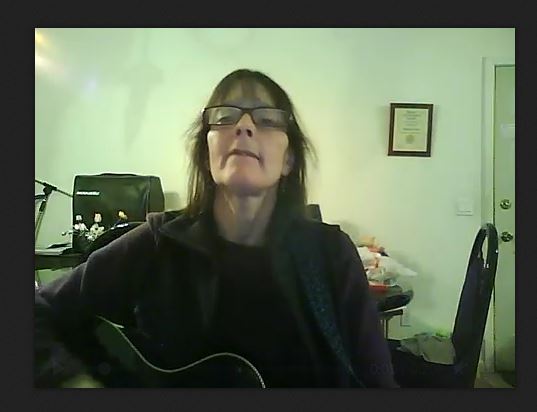
And then we grabbed as still image of the last video and put that still below.

And what did we come to learn from all this machine learning? Not that much at all.
Anger Is Never Inert
What our search for truth has taught us is that even the basest of emotions, like anger, are utterly unique to each person. The bitterness you feel about your worst day will manifest itself through your body differently than it will for someone else who’s having their worst day.
So while the top singer is the clear “winner,” with an anger score of 57%, compared to the 45% for the fellow at the bottom, the anger the singer on top senses can never be the same as the anger the bottom singer feels. That's always been the challenge of telling a great story. Human emotions are all about their human host and context. And in this angry age of ours, how interesting is it to realize, we may never be able to agree on what anger really is?
Which ’s why we are so bullish about seeking what is untrue in video and sound. We feel what's happened is the mother of all experiences. And that makes truth something that is reasonable to measure: What someone is authentically sensing has been man's trancendant story. So sensing how that sensibility radiates through a person, we should be able to determine when the real strays into the unreal.
We are here to provide the means to gently steer us all back towards seeing the world as it truly is.