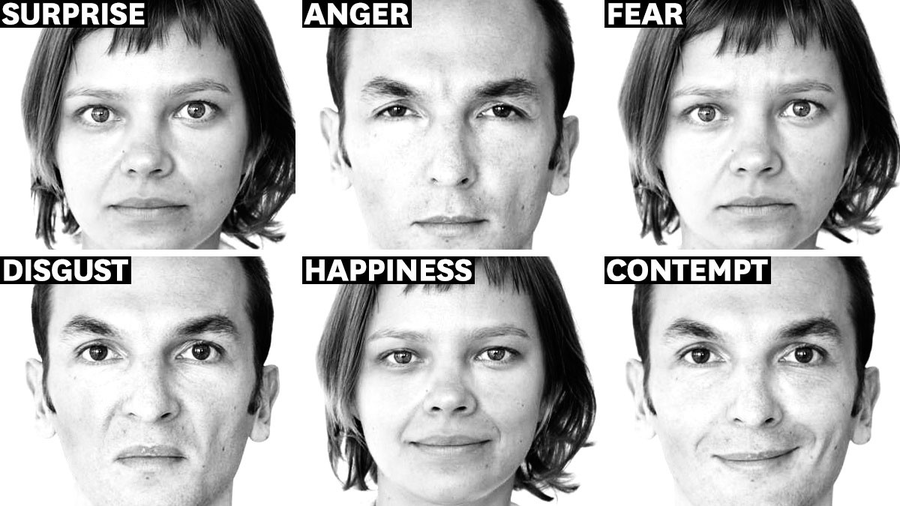
Tools that measure faint expressions of the face and body work. But with serious limitations.
To understand what makes microexpressions the right way to authenticate images, it's important to understand the wrong way they've been used in the past. Even as we've tinkered with the tiny expressions of the face, mouth and voice, and have built a business on tools related to these microexpressions, we've found there is a whole lot to be dubious about when it comes to the world of microexpressional analysis.
Here's what everybody should realize before they start working in this space:
Lack of Consistent Standards
A potentially crippling factor in creating tools to accurately assess these tiny gestures is that there is no consistent narrative about microexpressions and what they do. There have been widely quoted studies in the space for more than a decade. Perhaps the most popular was The Face of Success: Inferences from Chief Executive Officer's Appearnce Predict Company Profits, published in 2008. This reasonably sound scientific work was crafted by Nicholas Rule and Nalini Ambady. The duo measured the reactions of 100 undergraduates to various facial images of then-popular company CEOs. Then they used that data to predict a firm's profitability. Clever idea, for sure.
It was big news back in the day, when the likes of Inc. Magazine published results from that study asserting that David J. O'Reilly, CEO at Chevron, had microexpressions that glowed with "profitability" while Rick Wagoner over at GM had tiny facial gestures that reeked of loss and demise. It seemed like a no-brainer that corporate boards and capital markets would start modeling the microexpressions of managers to both keep them honest and predict company value.
But it never happened because the logic behind this study and others is based on disorganized intellectual property that is hard to replicate and build upon.
Almost Preposterously Complex Intellectual Property
What cripples the microexpressional thoughtspace is that nobody has a clear idea what that thoughtspace is. In the 12 months or so that we have been developing our tools and doing serious research, we've learned that organized intellectual property is almost impossible to come by.
Just look at the basic list of the topic areas where facial expressions play a role:
- We looked the use of vertex maps in cinematic special effects.
- We scanned computer vision and pattern recognition research.
- We looked at the technology behind so-called "de-aging" of actors.
- We dug into unsupervised video retargeting.
- We looked at the growing market in artificial voices.
- We studied other work in blink tracking.
- We touched on the perception of microexpressions in fields like sparse coding.
- We even looked at media forensics. and the related fields of discerning fake expressions from real ones.
Certainly the mathematics behind the vertex math and other tools needed to study faint expressions was absolutely solid. But the fungible applications of all these just seemed too complex to organize and use as a foundation for building reasonable intellectual property.
Keep in mind, we're not resource-constrained when it comes to intellectual property. We are professional researchers and patent holders. We can craft perfectly durable IP weaponry if we need to. Yet, it made no sense as a start-up to bother with a basic provisional patent because we honestly couldn't find where the prior art ended and the innovation began.
Consider the level of intellectual-property muddiness required to keep professional researches from finding value in doing research. That's some serious intellectual clutter.
Yet we still made progress with our tools. We are exiting our incubator phase this summer and we will begin working on a commercial tool. But we still get an eerie feeling that someone, somehow should come into the microexpressional space and organize it.
By all means, if you have an idea for forging the foundational work is this space, please contact us. We'd love to talk to you because we're betting there is nothing but upside potential here.